We use technically necessary cookies to make this website work. With your consent, we also use statistics and marketing services to improve our website, measure the success of our advertising and show you relevant ads on other platforms. Data may be transferred to countries outside the EU, such as the USA. You can change or withdraw your choice at any time via “Cookie settings” in the footer.
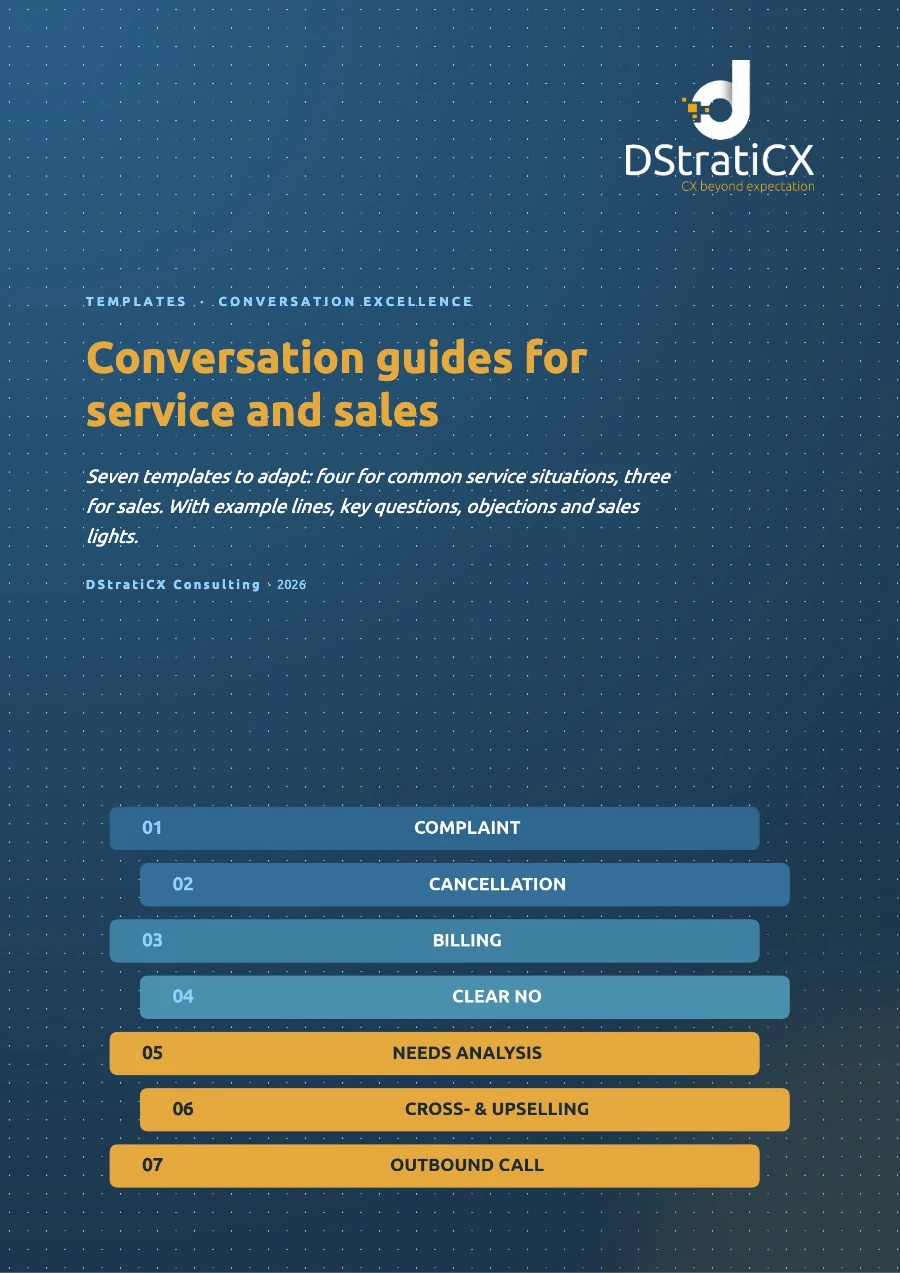
A guide is not a script. Customers notice at once when someone is reading aloud. These seven templates give structure and show by example how good calls sound: four for typical service situations, from complaints to a clear no, and three for sales, from needs analysis to outbound appointment setting. Every guide follows clear call phases, lists key questions and answers for tricky moments. Sales lights show when an offer fits a service call and when it does not. Fill in the placeholders in square brackets and the templates are yours within minutes.
At a glance
– The four service guides always follow the same five phases: Arrive, Understand, Guide, Resolve, Secure. The needs analysis for sales follows Neil Rackham's SPIN approach.
– The sales lights show red for complaints, payment problems and escalations: no offer today. Amber, for a cancellation request, means one offer at most that addresses the stated reason – after that, the customer's decision stands.
– For cross- and upselling, measure whether agents make offers on green, not the closing rate. Sometimes the best offer is pointing out a feature that's already in the customer's plan.
– Outbound starts with cards on the table: the opener calls a cold call a cold call and asks for 30 seconds to explain why. It ends with two specific time slots rather than an open question about availability.
– In a first call, the prospect does most of the talking. Eleven to fourteen good questions will do.
– Legal notes are built in, for instance on Section 312k BGB, the Federal Court of Justice ruling of 16 July 2026 on retention offers on cancellation confirmation pages, and keeping consent records for five years under Section 7a UWG.
Every guide is built the same way: the goal, typical triggers and how you know it worked. Then the call runs phase by phase, each with an example line and what to avoid. Key questions, tricky moments and a checklist for after the call complete the picture.
01 Complaint: from anger to resolution
02 Cancellation request: understand, retain, part fairly
03 Billing and payment question: explain the figures, pre-empt the next question
04 Bad news: clear in substance, warm in tone
05 Needs analysis in the first call: understand first, then offer
06 Cross- and upselling in service calls: solve first, then recommend
07 Outbound appointment setting: to the point, firmly booked
The tricky moments are often the most useful lines. What do you do when a customer in the middle of a complaint snaps “Then I'll just cancel!”? Sort out the problem first. The decision can wait until things have calmed down.
Legally sound, practised as a team
For team and department leads, trainers and quality managers who want to give their teams structure without imposing a script. Each template also comes as a separate Word file. Adapting them takes three steps: fill in the placeholders, read the example lines aloud as a team and rephrase them, then practise.
For practice, each guide lists the matching exercises from the toolbox “Conversations That Land” – for complaints, exercises 01, 02, 03, 05 and 08. The service guides use the conversation model from the playbook “Conversation Excellence That Sticks”. And where things get sensitive – cancellations, marketing calls, objections under Art. 21 GDPR – the notes sit right in the guide. Check the details with your legal team all the same.