We use technically necessary cookies to make this website work. With your consent, we also use statistics and marketing services to improve our website, measure the success of our advertising and show you relevant ads on other platforms. Data may be transferred to countries outside the EU, such as the USA. You can change or withdraw your choice at any time via “Cookie settings” in the footer.
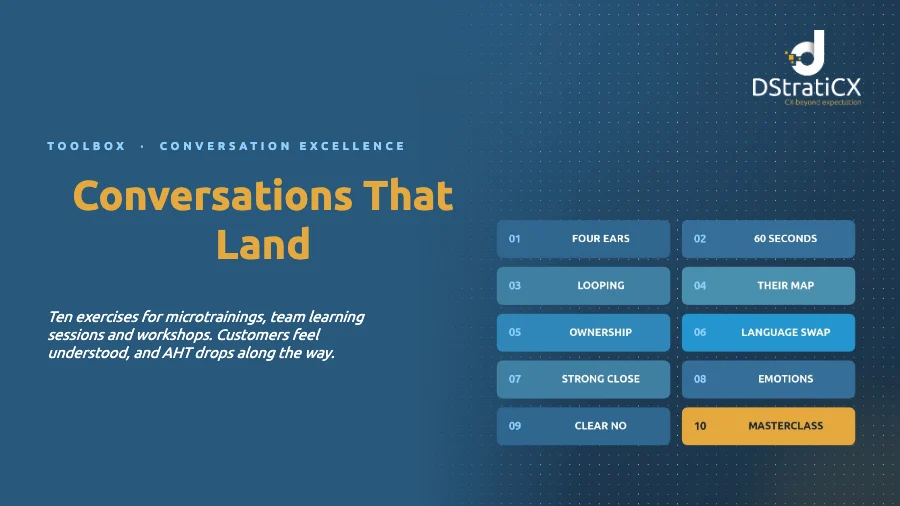
You know the feeling when someone on the phone is audibly working through a script? This toolbox trains the opposite. Ten exercises, ready for the daily huddle, a team learning session or a workshop: from Schulz von Thun’s four-ears model to looping, the customer’s map of the world and a clear no, with heart. Every exercise comes with a profile, a run-through and a trainer briefing on typical mistakes and how to correct them, plus templates for cards, cases and observation sheets. Learning paths serve beginners and seasoned experts alike. AHT drops along the way, because good conversations get it right first time.
At a glance
– Three formats for three situations: microtrainings of 10 to 20 minutes fit into the daily huddle, team learning sessions take 45 to 60 minutes, workshops two to three hours.
– A rule of thumb from training research: ten minutes every week beats one training day a year. Spread material over several sessions and people retain it far longer.
– Every exercise names its AHT lever. Take looping: a loop takes ten seconds, while solving the wrong problem costs minutes and often a second contact.
– Feedback comes with a rewind button. The agent says the critical sentence again straight away instead of just hearing an explanation – and the better behaviour is far more likely to carry over into daily work.
– The Expert Workshop taps into what your most experienced agents know. They write up the toughest cases from their own work, and the team plays them live in a fishbowl over 2.5 hours.
– The observation sheet ends with one overall question: as the customer, would I have called back?
The ten exercises build three skills. The first four are about understanding: spotting the pain point behind the request and checking you've got it right. Looping, for instance, is a technique journalist Amanda Ripley learned from mediator Gary Friedman. In The Customer's Map, each group explains the same unexpectedly high bill to four very different people: Rita, 74, who reads every line. Murat, 41, calling from his van between jobs. Lena, 23, for whom every euro is spoken for. And a managing director who needs a corrected invoice for accounts, in writing, today.
Exercises 05 to 07 stand for ownership: a personal, concrete sentence with “I”, what and by when. Exercises 08 and 09 combine clarity with empathy, right up to the yes–no–yes of negotiation expert William Ury. The Expert Workshop then brings it all together.
Five rules for practice that works
For team leads, trainers and anyone who wants to make practice part of everyday shift work. The structure rests on five rules from training research: principles rather than set wording, showing good and bad examples, using cases from your own team, practising short and often – and ending every exercise with a goal for the next shift.
Six templates, A to F, supply the material, from customer lines and feeling words to “no” case cards and the case sheet for the workshop. You'll spot progress in fewer repeat contacts within seven days, fewer transfers and more customer feedback with words like “understood”. The Conversation Guides for Service and Sales list the matching exercises for each situation, and the playbook “Conversation Excellence That Sticks” builds them into your leadership rhythm.