We use technically necessary cookies to make this website work. With your consent, we also use statistics and marketing services to improve our website, measure the success of our advertising and show you relevant ads on other platforms. Data may be transferred to countries outside the EU, such as the USA. You can change or withdraw your choice at any time via “Cookie settings” in the footer.
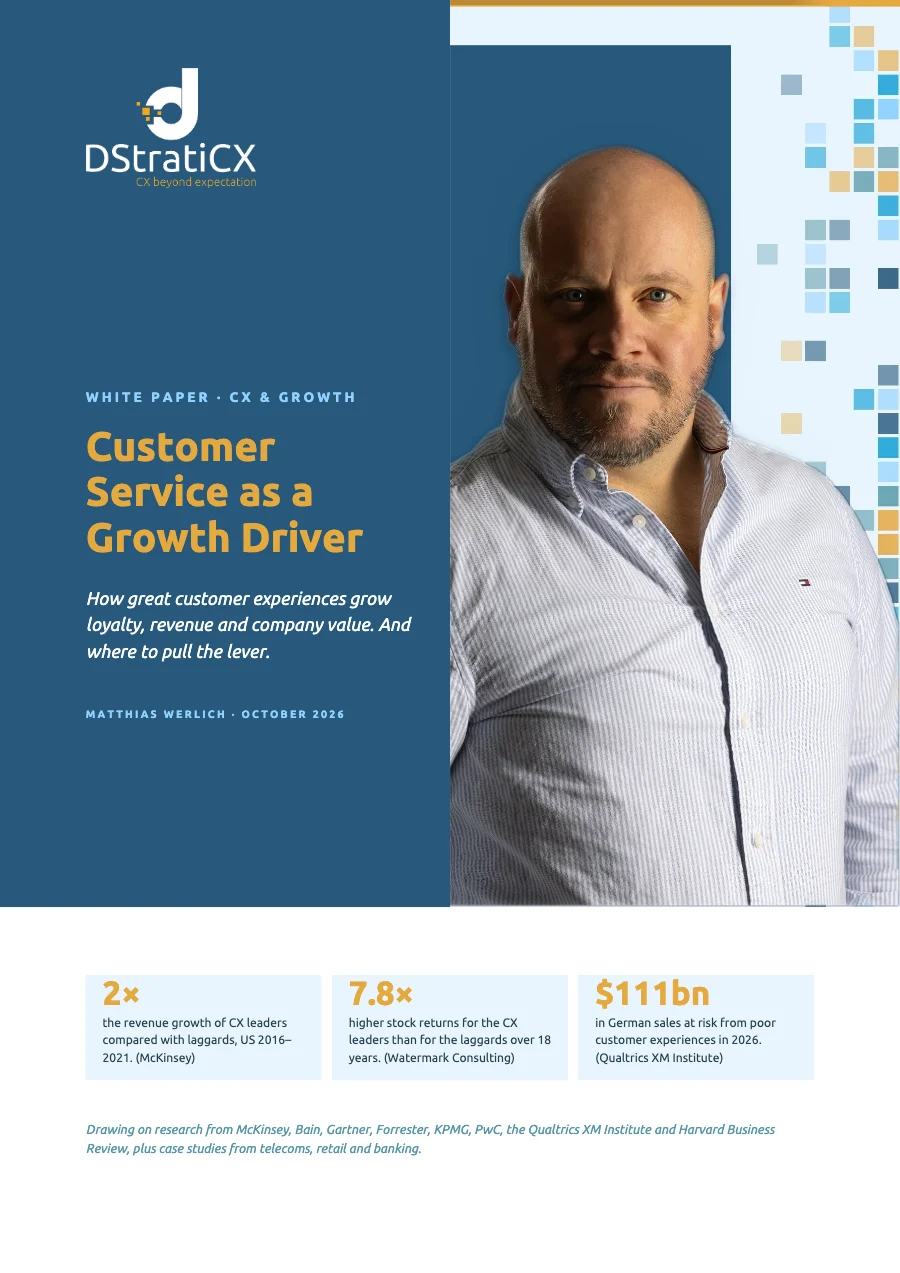
In many budget rounds, customer service only shows up on the cost side. Yet that is exactly where customers decide whether they stay, buy more and recommend you. This whitepaper brings together studies from McKinsey, Bain, Gartner, Forrester, PwC and the Qualtrics XM Institute with case studies from T-Mobile, Chewy and a mobile operator. It shows the four mechanisms through which great experiences create revenue, the three moments in service where growth is decided, the role of AI and five levers to get started.
At a glance
– According to McKinsey, around 80% of value creation at top growth companies comes from the core business. Lose one customer and you may need three new ones to make up for it.1
– Poor customer experiences put $111 billion of sales at risk in Germany in 2026 – 4.9% of consumer spending (Qualtrics XM Institute).2 In the DACH region, almost one in two would switch provider after poor service.3
– Over 18 years, the CX leaders achieved 7.8 times the stock returns of the laggards (Watermark Consulting).4 Loyalty leaders grow more than twice as fast as their industry (Bain).5
– Gartner's uncomfortable finding: a good service contact rarely builds loyalty, but a bad one reliably drives customers away. After a low-effort contact 61% of customers stay, after a high-effort one only 37%.6
– A US regional bank trained 400 service staff in needs-based conversations. Qualified leads rose by more than 60%, and revenue per call by 96%.7
– 64% of customers would rather companies didn't use AI in service, and 53% would consider switching.8 The answer is a division of labour: AI takes the routine, people take the moments where trust is at stake.
Revenue is the number of customers times the length of the relationship times purchase frequency times value per purchase. Marketing and sales mostly work on the first factor. The other three depend on what happens after the sale – and for many customers, that means service. Steer it only on cost per contact, handling time and headcount, and you optimise it downwards. The damage shows up quarters later.
The research shows what sits on the other side of the ledger. Customers with the best experiences spend 140% more than those with the worst (Harvard Business Review).[9] In one subscription business, 74% of members were still there a year after a top experience, against 43% after the worst.[9] Fred Reichheld showed for financial services that a 5% rise in retention lifts profits by more than 25%.[10]
The whitepaper also marks the limits. Forrester found no such link in healthcare. It holds where customers can switch and providers really differ in the experience they offer.
Five levers, no big programme
Written for CEOs, boards and heads of customer service, CX and sales, and above all for anyone who has to defend the service budget in the next round. Every figure is backed up, with 17 sources listed at the end.
The last chapter gets practical. Five levers put service and growth on one dashboard: calculate customer value by segment; put retention, repeat purchases and share of wallet next to cost per contact in the management report; cut repeat contacts and transfers and make first contact resolution a leadership metric; train needs-based conversations; and use AI where it makes people stronger. Besides T-Mobile and Chewy, results from Matthias Werlich's own line roles show it works: 30% more revenue in three years at TELUS International, and a turnaround at Transcom in Halle to a contribution margin of more than 30%.
Questions and answers
Customer service costs us a lot. Why shouldn't we cut it?
Because you would be cutting exactly where customers decide whether to stay. McKinsey found that around 80% of value creation at top growth companies comes from the core business, and you may need three new customers to replace one you lose.1 In the DACH region, almost one in two would switch provider after a bad service experience.3 The savings show at once; the damage shows quarters later.
Should we automate as much of our customer service with AI as we can?
Not as much as you can, but where AI makes your people stronger. In a Gartner survey, 64% of customers said they would prefer companies not to use AI in service, and 53% would consider switching.8 Their biggest fear is not reaching a human. So let AI handle the routine and supply knowledge in real time. Keep people for the moments where trust matters.
How do we turn customer service into a growth driver without a big programme?
With five levers you can move within a few months. Know what your customers are worth, by segment. Put retention and repeat purchases in the management report next to cost per contact. Cut repeat contacts. Coach needs-based conversations: a US regional bank raised revenue per call by 96% this way.7 And use AI where it makes your people stronger.