We use technically necessary cookies to make this website work. With your consent, we also use statistics and marketing services to improve our website, measure the success of our advertising and show you relevant ads on other platforms. Data may be transferred to countries outside the EU, such as the USA. You can change or withdraw your choice at any time via “Cookie settings” in the footer.
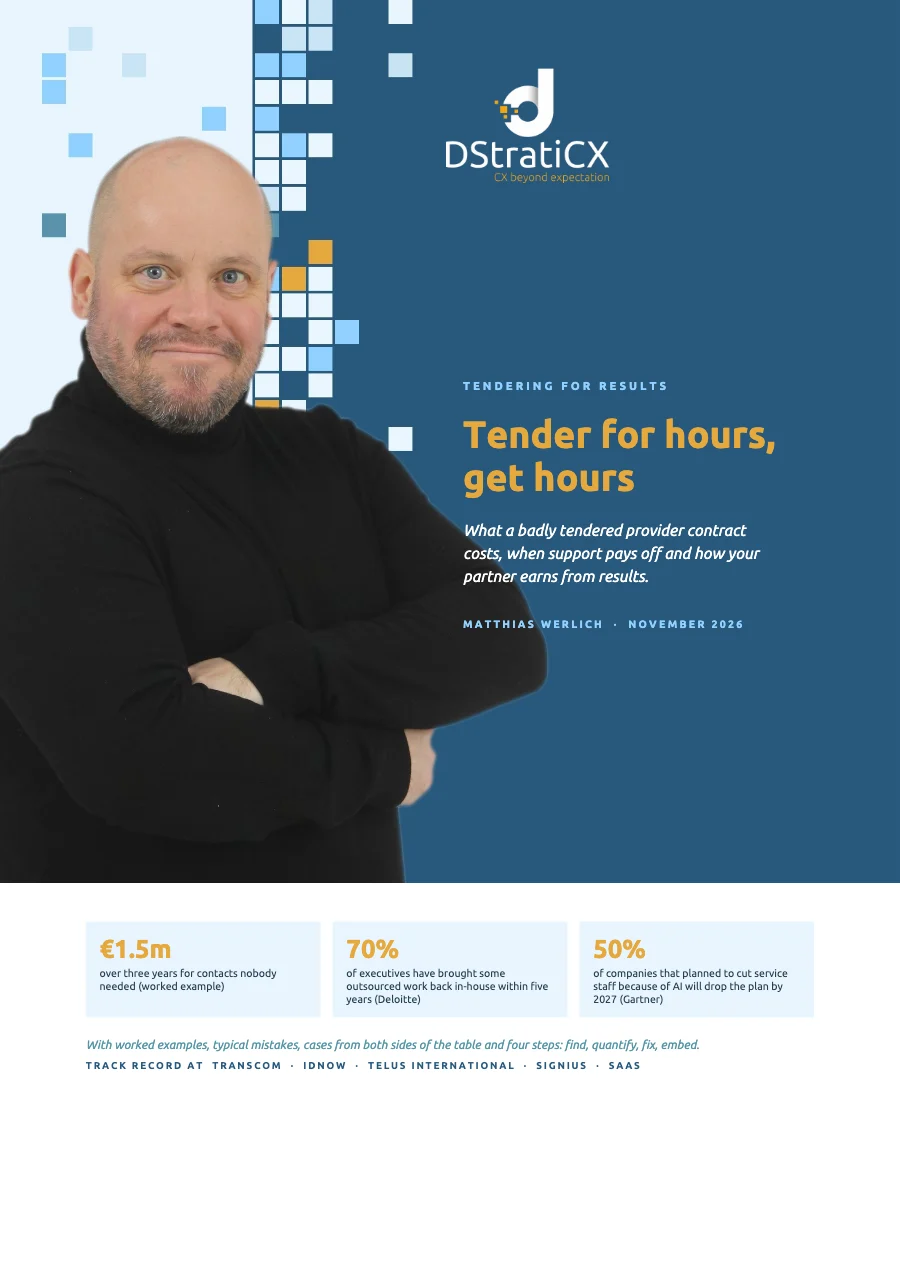
Most customer service tenders end with the hourly rate. Yet most of the money is decided earlier: by which contacts you buy in the first place. This whitepaper works out what’s in it: with 100 service FTE and a three-year term, 10% avoidable contacts cost around €1.5m. It shows where tenders go wrong, compares four routes to your next provider contract and lays out the four steps: find, quantify, fix, embed. It adds cases from Transcom, IDnow, TELUS International and Signius, and straight answers to common questions.
At a glance
– A customer service provider contract is negotiated once and paid for years. Most of the money is decided before the tender: by which contacts you buy in the first place.
– The worked example: 100 service FTE at a provider at €50,000 each come to €15m over three years. If 10% of contacts are avoidable, you are buying around €1.5m you don’t need.4
– According to Deloitte, 70% of executives surveyed have brought some outsourced services back in-house over the past five years.1 A contract that doesn’t fit costs you twice: first in operation, then when you switch.
– A price per resolved issue, bonus and malus on repeat contacts and satisfaction, an evaluation based on total cost rather than the hourly rate: that is how your partner earns from results.
– The whitepaper is upfront about when support won’t pay off: when all you want is the cheapest hourly rate, when you won’t share numbers, or when a renegotiated contract with your current partner is enough.
– Getting started is the 30-minute Results Check: one number in euros, the three biggest levers and one action for Monday, as a memo the next working day.
The core argument: tender for hours and hours is what you get. Many tenders run by the book, with the old service specification, current volumes and a comparison of hourly rates at the end. Hardly anyone asks whether some of the calls come from a confusing invoice or a clunky process. Add the usual mistakes: too little data for bidders, too many bidders, testing only after signing and no plan for the exit.
Five chapters take you from diagnosis to decision:
01 What a badly tendered contract costs
02 When support pays off, and when it doesn’t
03 How I work: find, quantify, fix, embed
04 Does it work in practice?
05 Straight answers and how to start
Along the way you get the three levers: only buy what you need, pay for results and know how bidders calculate.
Both sides of the table
Written for managing directors, procurement and heads of service in mid-sized companies, and readable in about 12 minutes. Matthias Werlich knows both calculations. At Transcom he ran a provider site with full P&L and €10–30m in revenue. At IDnow, on the client side, he managed 950 FTE in six countries and cut the cost per transaction by 14%. At TELUS International he made a project the site’s flagship, and at Signius he built a high-performing sales organisation for the DACH region.
It is just as clear about what you need to bring: management that backs the decision, figures on volumes, contact reasons and cost, and procurement and legal advice for the process and the contract. For the two-page version of the offer, see the solution brief “Tendering for Results”.
Questions and answers
Our procurement team can run tenders. Why would we need outside support?
Your procurement team knows the process. What is often missing is the substance: which contacts you really buy, which pricing model fits and where bids have slack. That is where it is decided whether the contract saves money over its term or keeps paying for contacts nobody needed.
Our provider contract still runs for twelve months. Is it too early to start?
If anything, it’s tight. Tender, negotiation and transition take time, and after go-live it often takes four to six months or more before the new operation is fully integrated.2 Your negotiating position is built now. Plan that time in, or you pay for it in quality.
Bidders promise a lot of AI. How much of it is real?
Only a test before signing will show. Gartner expects that by 2027, half of the organisations that planned to cut service staff significantly because of AI will abandon the plan.3 So write AI effects into the contract as measurable results, not as promises in a bid.