We use technically necessary cookies to make this website work. With your consent, we also use statistics and marketing services to improve our website, measure the success of our advertising and show you relevant ads on other platforms. Data may be transferred to countries outside the EU, such as the USA. You can change or withdraw your choice at any time via “Cookie settings” in the footer.
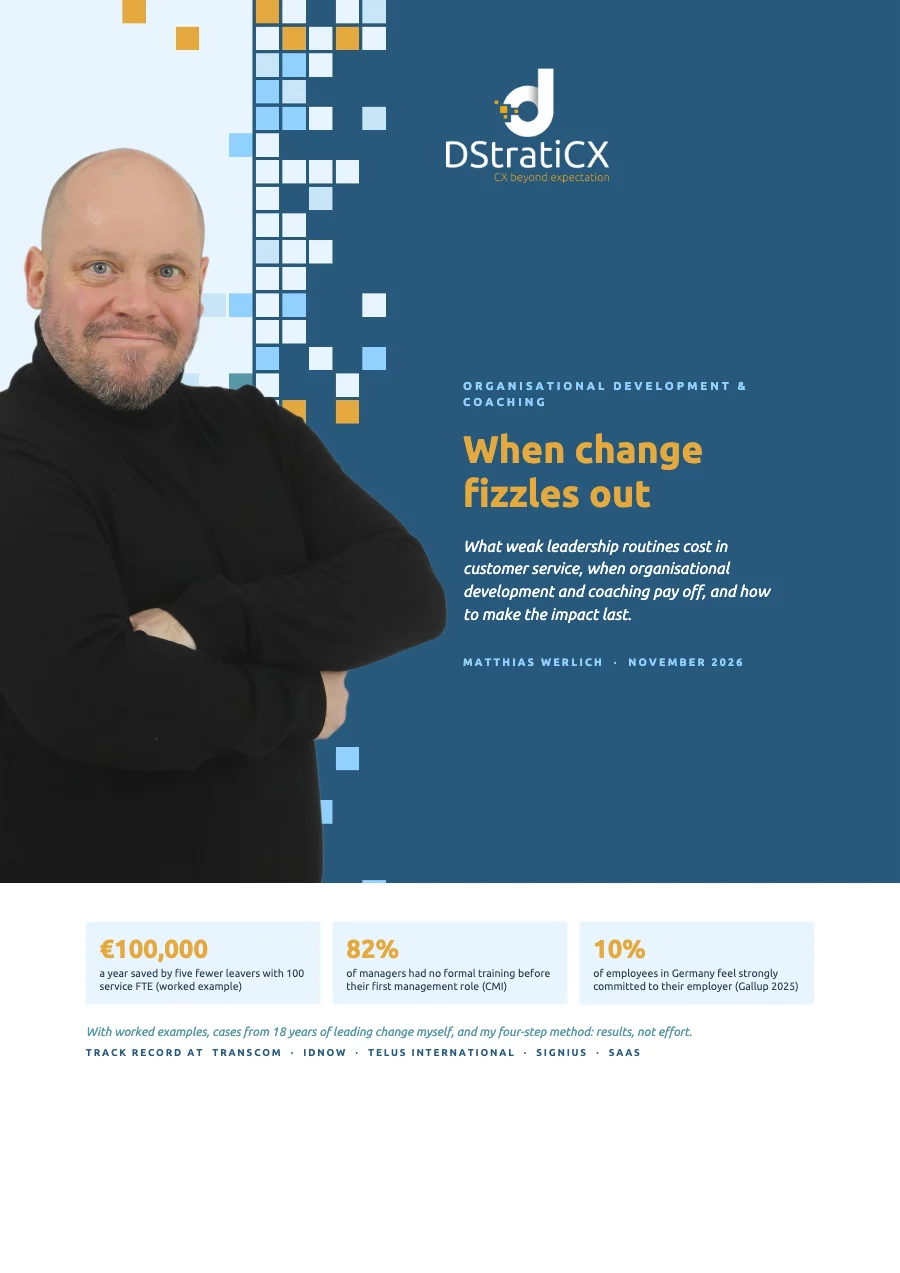
Most change in customer service starts with a sound plan and still fizzles out in daily work. This whitepaper works out what weak leadership costs: around €600,000 a year in replacement costs with 100 service FTE and 30% attrition. It compares seminars, big consultancies, internal projects and working with DStratiCX, and lays out the roadmap for the first 100 days. It adds cases from TELUS International, Transcom and IDnow, and straight answers to common objections.
At a glance
– 82% of managers had no formal training before their first management role, according to the Chartered Management Institute. One in three respondents had quit a job because of a negative work culture.1
– Only 10% of employees in Germany feel strongly committed to their employer, and 13% have mentally checked out (Gallup Engagement Index 2025).2
– 52% of leavers say their manager or organisation could have kept them.3 Often an honest conversation at the right time would have done it.
– Set that against €100,000 a year in the worked example if just five people stay who would otherwise have left.4
– Ten proven leadership formats, from daily huddle and 1:1 to business review – picked to fit and practised until they stick.
– At Transcom in Halle the site grew from 220 to 450 people. With redrawn leadership layers, people KPIs rose by 4 to 9%.
In customer service, the team lead decides whether new starters are still around after three months, whether feedback lands and whether Monday's rota holds. Yet the job often goes to whoever had the best numbers on the team. From then on, they lead by gut feel.
That's where the whitepaper starts. First come roles and interfaces: who decides what, who escalates where, who owns which KPI? As long as that's unclear, any training goes to waste. Next come fixed leadership routines that run in daily operations, often in meetings you already hold. Finally, team leads learn to hold tough conversations, steer performance and explain change.
A sample programme covers eight days of support on roles, routines and change, two workshops with the leadership team and a coaching package for the head of department, ten 90-minute sessions. We'll tell you the price in the results check, once we know the scope.
When it pays off – and when it doesn't
Written for managing directors, HR and heads of customer service in mid-sized companies. It's worth it when you're growing and need new teams, layers or sites, when a big change is coming – a merger, a sourcing switch, a founder handover or an AI roll-out – or when new team leads are being promoted from within. The whitepaper is just as clear about the limits: if the department has no head at all, you need someone to lead first. And without senior management behind it, no change can be forced.
You take away a worked example to rerun with your own numbers, and a list of what you need to bring yourselves, right down to a willingness to look at uncomfortable findings. For a compact version of the offer, see the solution brief “Organisational Development & Coaching”.
Questions and answers
Does coaching our team leads deliver anything measurable?
Yes, if you agree up front what gets measured. At the start you set KPIs such as attrition, sickness rate, satisfaction or quality, then review them with DStratiCX after 100 days. The worked example shows what is at stake: with 100 service FTE and 30% attrition, replacing leavers costs around €600,000 a year. Five fewer leavers save €100,000.4
Why not just book a leadership seminar?
Because a seminar passes on knowledge but doesn't make sure it reaches the team on Monday. Daily work decides that. According to Gallup, 52% of people who quit say their manager or organisation could have kept them.3 Often an honest conversation would have done it. So Matthias Werlich works with your KPIs, your teams and your meetings, and stays until the routines run.
When is organisational development not worth it for us?
When your service department has no head at all. Then coaching won't help much, and you need someone to lead first, perhaps on an interim basis. For standard training across the whole company, a seminar provider is cheaper. And if senior management isn't behind the change, even the best support can't force it. DStratiCX will tell you that in the 30-minute Results Check.