We use technically necessary cookies to make this website work. With your consent, we also use statistics and marketing services to improve our website, measure the success of our advertising and show you relevant ads on other platforms. Data may be transferred to countries outside the EU, such as the USA. You can change or withdraw your choice at any time via “Cookie settings” in the footer.
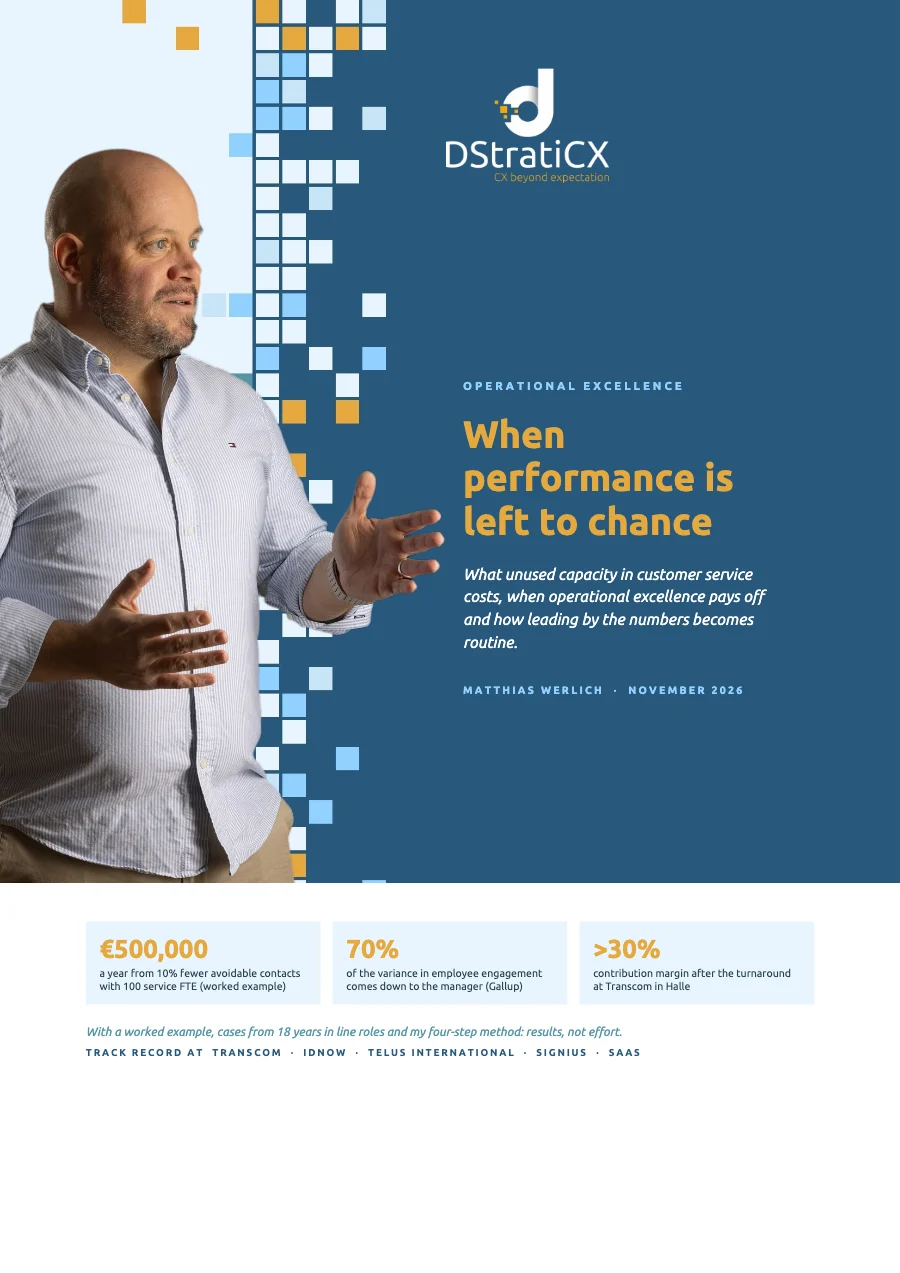
Many service organisations have enough people; they just use them unevenly. This whitepaper puts a number on the variance between teams, shifts and individuals: with 100 service FTE, 5% better use of resources is worth around €250,000 a year, without a single new hire. It shows when operational excellence pays off and when it doesn't, compares four ways to raise performance and sets out the roadmap for the first 100 days, from performance check to playbook audit. With cases from 18 years in line roles, including the turnaround at Transcom in Halle.
At a glance
– The biggest efficiency lever in customer service rarely lies in new technology. It lies in the variance between teams, shifts and individuals.
– Not everyone needs a programme: with fewer than around 15 FTE, the free playbook and toolkit are usually enough. With no head of service at all, an interim mandate is the better route.
– Operational excellence means every level knows its contribution to the result, from agent to site director, and leaders lead with it every day.
– Homework first, then the price: before you negotiate price, budget or headcount, your own levers are used up, from AHT to utilisation to quality.
– Set against that, the worked example shows €500,000 a year. Get just half of it and that is still €250,000.2
– At Transcom in Halle, operational excellence was an important lever in the turnaround: contribution margin steady above 30% afterwards, growth from 220 to 450 employees.
The whitepaper starts from a simple observation: the best team works with the same processes and systems as the weakest one. What makes the difference is how close leaders are to the numbers and to their people. Matthias Werlich developed operational excellence as a site director at a contact centre provider, with one clear rule: do your own homework before you negotiate price.
The roadmap for the first 100 days is concrete: a performance check after two weeks, KPI tree, scorecards and meeting cadence from day 30, on-site support for team leads and the playbook audit on day 100. The Performance Playbook and Toolkit are part of the programme.
Five chapters:
01 What unused capacity costs
02 When operational excellence pays off, and when it doesn't
03 What happens in the first 100 days
04 Does it work in practice?
05 Straight answers and how to start
For the leadership team
For managing directors, heads of division and site directors in customer service, in-house and at service providers. You come away with a calculation you can rerun with your own numbers, and a comparison of four ways to raise performance: a new tool, a big consultancy, more staff or operational excellence.
The whitepaper also says when to leave it: below around 15 FTE, when there's no head of service at all, or when KPIs are only meant for control. Where it fits, the free 30-minute Results Check shows which levers will make the biggest difference for you.
Questions and answers
We already have reporting. Why isn't that enough?
Because reporting only shows what happened. A dashboard doesn't change a single number until leaders work with it. Operational excellence makes sure they do, every day: in the huddle, in coaching, in the 1:1. That matters, because Gallup finds that managers account for at least 70% of the variance in employee engagement.1 What counts is what leaders do with the number the next morning.
Isn't operational excellence just more pressure on the team?
No. People who know their contribution and get regular feedback and development are more engaged and stay longer. Pressure comes where numbers are handed out without a conversation. At TELUS International in Leipzig, employee satisfaction rose 27% in 18 months under Matthias Werlich. If KPIs are only meant for control, no coaching will reach the team. We'll tell you that in the Results Check.
How large does our service operation need to be for this to pay off?
Usually from around 15 service FTE, especially when performance varies widely between teams, shifts or sites. Below that, the free Performance Playbook and Toolkit are usually enough. For scale: with 100 service FTE at €50,000 fully loaded cost each, 5% better use of resources is worth around €250,000 a year, without a single new hire.2 With no head of service at all, an interim mandate is the better route.