We use technically necessary cookies to make this website work. With your consent, we also use statistics and marketing services to improve our website, measure the success of our advertising and show you relevant ads on other platforms. Data may be transferred to countries outside the EU, such as the USA. You can change or withdraw your choice at any time via “Cookie settings” in the footer.
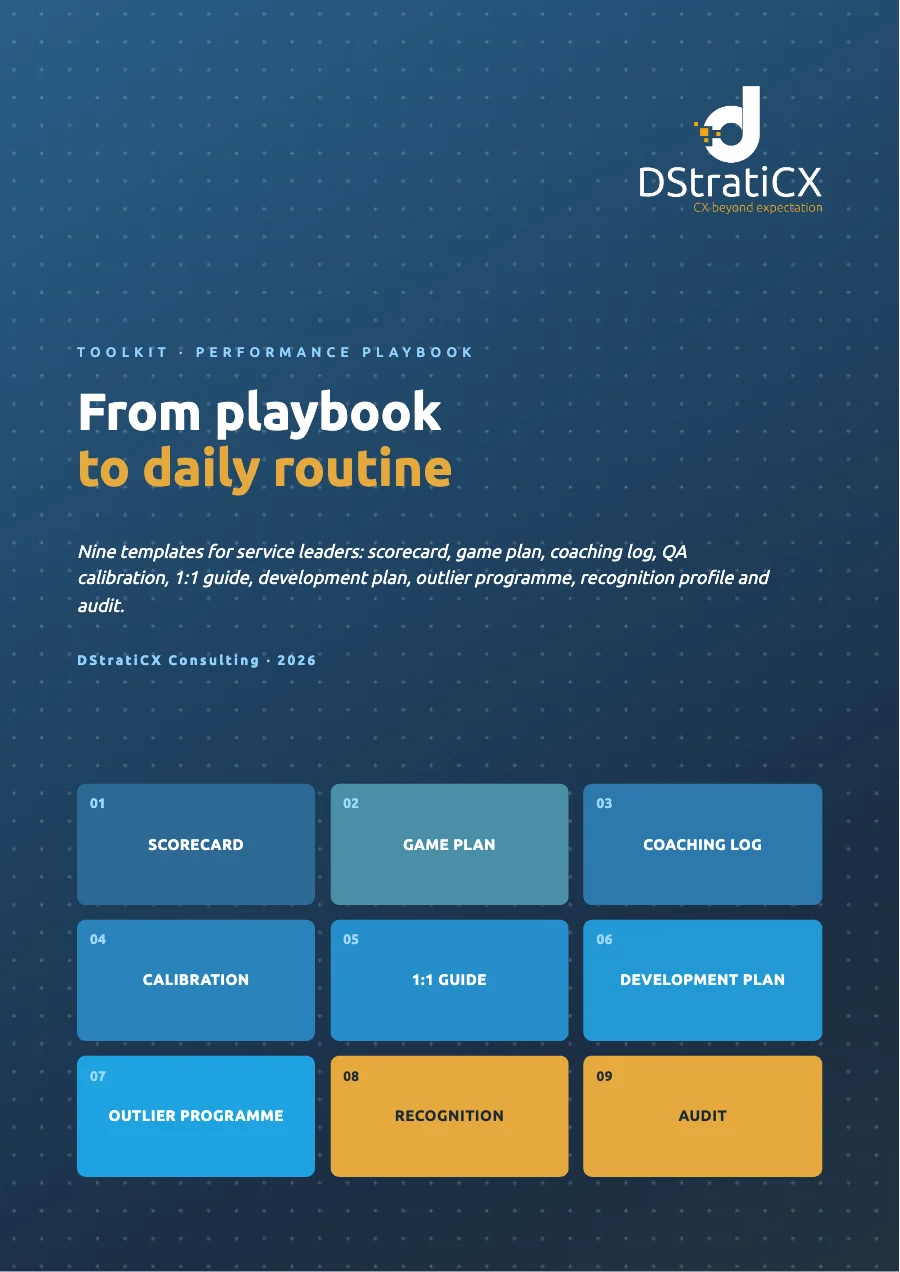
A playbook changes nothing while it sits in a folder. The toolkit gives you the right tool for each of the seven habits: a performance scorecard that weights KPIs and builds quartiles, a daily game plan for ten minutes each morning, a coaching log that reminds you to follow up, a QA calibration sheet, a 1:1 guide with GROW questions, a development plan built on if-then plans, the outlier programme for the bottom quartile, a recognition profile and the playbook audit after two months. All in Excel and Word, easy to adapt, with sample data and sources.
At a glance
– More than 3,000 formulas take the legwork off your hands: the Excel templates weight KPIs, build quartiles, remind you to follow up and show where assessors disagree.
– The scorecard caps target attainment at 120%, so one stellar number can't hide a weakness elsewhere. For each person it suggests a coaching focus: the KPI with the largest weighted gap to target.
– Feedback can backfire. In Kluger & DeNisi's meta-analysis it made performance worse in more than a third of cases, especially when it targeted the person. So the templates ask about behaviour and the task.
– If-then plans beat good intentions: a meta-analysis by Gollwitzer and Sheeran found a medium-to-large effect on goal attainment (d = 0.65).
– Only one employee in eight has ever been asked how they like to be recognised. The recognition profile fixes that in ten minutes.
– The audit counts evidence, not self-assessment. The reason: 50% of managers say they give feedback weekly, but only 20% of employees experience it that way.1
Every template comes with instructions, its calculation logic, a sample view and the research it builds on. A few examples. In QA calibration, everyone scores the same calls alone first, then you compare. Anyone outside the ± 5 percentage-point tolerance against the reference shows up as more lenient or stricter. If a criterion has more than one point between scores, it needs a clearer anchor.
The coaching log sets the follow-up for the next working day and works out how often agreed changes actually stick. The outlier programme measures progress between baseline and target – including for KPIs like AHT, where lower is better – and flags “decision due” if less than half the gap has closed after the minimum period. The playbook audit puts 21 questions to three levels and flags it when team leads sit 25 points or more above their employees.
Three steps to get started
Made for team leads, business managers, trainers and quality leads. Start with the scorecard: it delivers the quartiles and coaching focus that everything else builds on. Then dock the game plan, coaching log and 1:1 guide onto your team leads' routines, and launch the outlier programme for quartile 4. After two months, the audit shows what holds.
The Word templates are more than forms. The 1:1 guide gives you a five-part agenda, a question bank based on John Whitmore's GROW model and three traps that ruin any 1:1 – such as talking more than the other person. The development plan draws a clear line between itself and a formal performance improvement plan, so your bottom quartile doesn't read it as the first step towards dismissal. The thinking behind every template is in the Performance Playbook for Leaders.