We use technically necessary cookies to make this website work. With your consent, we also use statistics and marketing services to improve our website, measure the success of our advertising and show you relevant ads on other platforms. Data may be transferred to countries outside the EU, such as the USA. You can change or withdraw your choice at any time via “Cookie settings” in the footer.
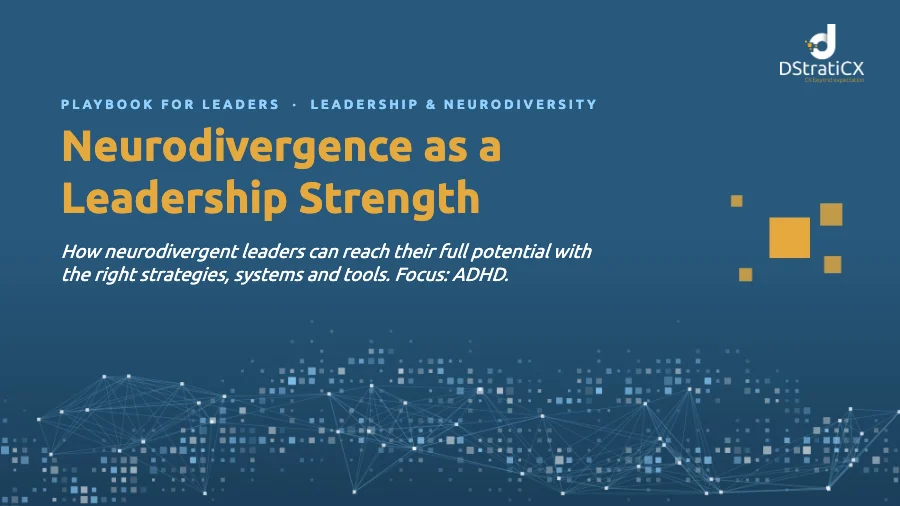
Neurodivergence acts as an amplifier – used well, it becomes a genuine leadership strength. This playbook translates the research into a practical toolkit in three steps: Understand how your mind works and why fit matters more than perfection. Design an external operating system of rituals, tools and clear rules. And Impact – use roles, teams and AI so that difference turns into results. The goal: deploy strengths deliberately and secure weak spots with systems rather than willpower. With a focus on ADHD.
At a glance
– Five modules take you from your own mind to the wider organisation: Understand, Deploy strengths, Build your system, AI as an exoskeleton, and Team & organisation.
– A self-check with six statements on focus, time, energy, emotion, ideas and crisis shows where your levers are and where you need backup. Explicitly not a diagnostic tool.
– The daily architecture plans by energy, not by the clock: a 10-minute morning check, a 90-minute focus block, batched meetings, 45 minutes of admin in the dip and a 10-minute shutdown.
– A decision ladder sorts calls by impact. Small and reversible ones get made on the spot, medium ones after a night's sleep, big and irreversible ones only with a sparring partner and options weighed in writing.
– Six prompt templates and clear guardrails make AI a relief rather than one more distraction – from a weekly plan with a 50% buffer to asking what the case is against your favourite option.
– A 30-day plan brings it all into daily life within four weeks: self-check and your own system first, then AI routines, and finally a shared working manual and an agreed tandem.
Light on text, heavy on tools. Module 1 puts the research in context, takes apart the myth of “multiple focus” and ends with the self-check. Module 2 turns the five potentials into roles: transformation, go-lives and escalations on one side; routine reporting, compliance and budget planning as jobs for a tandem on the other.
Module 3 is the core. Six building blocks – capture, plan, focus, decide, recharge, communicate – make up the external operating system. They come with five meeting rules, such as an idea parking lot for exciting tangents and a short break after 45 minutes. Module 4 adds five AI use cases plus dos and don'ts. Module 5 covers the complementary leadership team of visionary, integrator and implementer, eight building blocks for the organisation and a four-level maturity model.
From reading to trying it out
For neurodivergent leaders, above all those with ADHD. Module 5 also speaks to HR and organisational development, because nobody builds fit on their own.
One of the most practical pages is the personal working manual. Six fields, from “The best way to reach me” to “When things get heated”, tell your team how you work. Whether you disclose a diagnosis is up to you – the manual works without it. The limits are spelled out too: the playbook is not a diagnostic tool and doesn't replace medical advice.
The studies behind every page, with full references and links, are in the article “Neurodivergence as a Leadership Strength”.